
Customer relationships are entering a new era, one defined by real-time intelligence and AI systems that do far more than automate tasks. But more customer signal requires better management. Salesforce found that 62% of IT leaders say their organization isn’t yet equipped to harmonize data systems to fully leverage AI. 
Traditional CRMs can no longer keep up with the speed, personalization, and data management modern teams need. That shift is driving the future of AI in customer relationship management. Tools, like HubSpot Smart CRM, give businesses a unified view of the customer. Teams have all the tools they need, all in one place, so they can build personalized experiences that drive business.
This post breaks down what’s coming next, how AI will reshape go-to-market collaboration, and the practical steps teams can take today to prepare.
Table of Contents
- Current Trends in CRM Teams Can Act on Now
- The future of AI in customer relationship management starts with unified data
- What is the future of CRM with AI, and how will it change go‑to‑market teams?
- Future of AI in Customer Relationship Management for Marketing Teams
- Future of AI in Customer Relationship Management for Sales Teams
- Future of AI in Customer Relationship Management for Service Teams
- Frequently Asked Questions About the Future of AI in Customer Relationship Management
The future of AI in customer relationship management starts with unified data
AI can only be as powerful as the data it learns from, which is why the next generation of CRMs builds a single, connected source of customer truth. As companies adopt more channels and more tools, customer information becomes fragmented across systems. The result is low-quality data that hinders AI operations, limiting the accuracy ot predictions and recommendations.
Unified platforms like HubSpot CRM bring customer insights together. Every interaction, property, and behavioral signal flow is logged in one clean, consistent CRM. With better-quality data, AI can detect patterns in real time. In other words, unified data is the foundation for AI-powered businesses.
Why unified data is the foundation for AI-powered CRM
AI relies on context. Without unified data, context is incomplete. When teams rely on disconnected systems, AI struggles to understand the full customer journey. AI tools may see an email click in one platform, but miss a support ticket in another. Or perhaps, a forecasting model evaluates the customer’s journey stage without knowing the lead’s past interactions. The result is inaccuracies at scale.
A unified CRM eliminates this problem by providing:
- A 360-degree view of the customer. All marketing, sales, and service interactions live in one place. AI systems get full visibility into intent, health, and historical behavior.
- Clean, consistent customer records. Duplicate contacts and mismatched properties degrade AI accuracy. A unified CRM standardizes and maintains consistent customer profiles.
- Real-time signals for real-time decisions. Unified data ensures that AI copilots and agents use current behaviors, not outdated snapshots, to take action.
- Cross-team alignment. When every department works from the same data foundation, AI can facilitate smoother handoffs and surface insights that benefit the entire go-to-market engine.
HubSpot Smart CRM actively integrates with Sales Hub, Service Hub, and Marketing Hub. Customer interactions across teams are logged within one AI-powered system.
How unified data fuels the future of CRM
The most important shift in the future of AI in customer relationship management is the move from descriptive data (what happened) to agentic systems (what should happen next). Predictive tools need access to a large volume of clean data. HubSpot AI CRM gathers customer insights into a single, structured environment.
Here are the different functions powered by unified data.
1. Personalization at scale
AI can tailor emails, outreach, and recommendations. How? AI systems synthesize data from across the customer journey. AI can understand inputs when leads fill out a form or assess a journey stage from interactions on a business’ site. From there, AI systems can show offers that are personalized to the site visitor.
How HubSpot can help: HubSpot Content Hub uses a targeting feature powered by data stored in the Smart CRM. Pages can then dynamically adapt homepage modules based on customer data.
2. Predictive accuracy for revenue and churn
AI models need large sets of unified data to forecast outcomes. A CRM, like HubSpot, can store that historical data to better train AI-powered prediction tools. The most accurate predictions come from datasets that include marketing interactions, sales activity, service cases, and product usage, not just pipeline stages.
How HubSpot can help: Teams using Sales Hub can leverage Breeze to project future sales based on deals in the past three months.
3. Autonomous actions with agentic AI
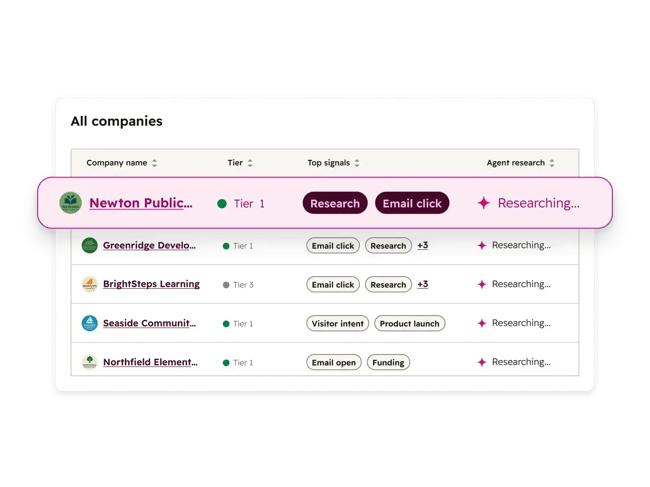
AI agents trained by customer data can handle routing actions, so teams can focus on complex problem-solving. With the proper workflows, agentic AI can qualify leads, route tickets, and update properties to keep CRMs clean.
How HubSpot can help: Breeze, HubSpot’s AI tool, offers built-in engines that can help teams across the business with routine tasks. Breeze already has a prospecting agent to help prep reps for client calls and a customer service agent to solve routine help tickets.
4. Stronger collaboration across marketing, sales, and service
Unified data acts as the connective tissue between teams. AI then uses that connection to orchestrate the entire customer journey — ensuring that insights surfaced in one department improve outcomes in another.
For example,
- A service agent resolves an issue.
- AI automatically updates account health.
- An account executive receives a predicted churn signal and focuses on nurturing the relationship.
That coordination is only possible with unified CRM data at the center.
What is the future of CRM with AI, and how will it change go‑to‑market teams?
The future of AI in customer relationship management is defined by a major shift: CRM systems are moving from rule-based automation toward agentic AI. Agentic tools are capable of reasoning and taking autonomous actions within the go-to-market motion.
For the last decade, most CRMs relied on if-this-then-that logic. These systems would trigger predefined workflows. However, traditional CRMs couldn’t interpret intent or adapt to changes in context. That limitation forced teams to manually fill the gaps. AI removes that bottleneck for go-to-market teams by shifting the CRM from a system of record to a system of intelligence.
Modern GTM teams require speed, shared context, and precise coordination. AI improves all three.
1. AI removes friction between teams
Marketing, sales, and service often operate on different timelines and under different pressures. AI becomes the intermediary that ensures no insight stays siloed.
What this enables:
- Marketing knows which messages drive high-quality conversations
- Sales sees support risk before renewal calls
- Service agents get context from sales handoffs instantly
When all teams rely on the same real-time AI insights, alignment becomes the default instead of a recurring challenge.
2. AI changes GTM execution from reactive to proactive
Historically, GTM teams reacted to signals, like form submissions, tickets, and demo requests. Agentic AI flips the model. Instead of waiting for events, agents predict them. That means:
- Leads get nurtured earlier
- Deals are prioritized more accurately
- Service issues are triaged before they escalate
- Churn indicators are flagged before renewal conversations
3. Agentic AI makes CRMs operational, not administrative
In the future of CRM, teams will spend far less time updating records and far more time interacting with customers. AI will maintain data hygiene, orchestrate workflows, and surface insights without requiring manual effort.
With this shift:
- Reps will spend more of their day in conversations instead of admin work
- Managers will spend less time requesting reports and more time coaching
- Marketers will spend less time analyzing performance and more time optimizing messaging
- Service agents will respond faster because the CRM provides the full story instantly
HubSpot Sales Hub already uses AI to automate research, enrich records, and generate reporting insights — removing layers of manual effort that GTM teams previously accepted as unavoidable.
Future of AI in Customer Relationship Management for Marketing Teams
AI is reshaping how marketing teams understand customers, build relationships, and create personalized experiences at scale. Marketing Hub and other AI-powered tools connect to CRMs, allowing access to a wealth of data that can build personalized marketing experiences. Marketers can then evaluate behavior and deliver content tailored to each stage of the customer journey.
Below are the three AI trends every marketing leader should prioritize when planning for the future of AI in customer relationship management.
Predictive segmentation becomes the backbone of lifecycle marketing
For years, segmentation relied on static rules: demographic filters, firmographic traits, or simple behavioral properties. AI changes that by identifying patterns across channels and predicting what a customer is likely to need next. Instead of grouping contacts by past actions, predictive segmentation groups them by future intent.
With AI-driven CRM systems like the HubSpot, marketers can forecast the leads that are likely to convert, which are at risk of churn, and which accounts have growth potential. This transforms segmentation from guesswork into a continuous intelligence loop supported by unified customer data.
Hyper-personalized content becomes real-time and channel-aware
The next wave of CRM intelligence enables marketing teams to generate content dynamically, tailored to each customer’s context, tone preferences, engagement history, and stage in the relationship.
AI also unlocks channel-aware personalization. It recognizes how each customer interacts — email, chat, social, or in-product. The system can then adjust timing, tone, and message format automatically.
Journey orchestration shifts from manual workflows to autonomous optimization
Historically, marketers built workflows based on fixed triggers and logic trees. If a contact downloads an ebook, send email X. If they visit the pricing page, enroll them in sequence Y. This rule-based automation worked when customer paths were predictable. Today, they aren’t.
Agentic AI allows CRMs to orchestrate journeys dynamically. Instead of relying on fixed rules, AI evaluates full customer context and adjusts the journey in real time.
This evolution helps marketing teams:
- Serve relevant content at the right moment
- Reduce nurture fatigue
- Improve sales-readiness scoring
- Personalize messaging across the entire funnel
- Increase the speed of sales handoffs
Future of AI in Customer Relationship Management for Sales Teams
AI is reshaping how sales teams build relationships, qualify pipeline, and guide buyers through increasingly complex journeys. In the future, reps won’t just have better tools. They’ll have intelligent systems that anticipate buyer needs, surface actionable insights, and automate the busywork that prevents them from selling.
The biggest shift is not more data but more clarity. AI enables every rep to see the right accounts, take the right actions, and communicate with the right message at the right moment.
Below are the three trends modern sales leaders should prioritize.
AI-guided selling turns every rep into a top performer
For years, sales enablement relied on static playbooks, training sessions, and manual research. AI changes this entirely. Instead of forcing reps to search for insights, AI agents can help automate the research process, all with context from AI-powered CRMs.
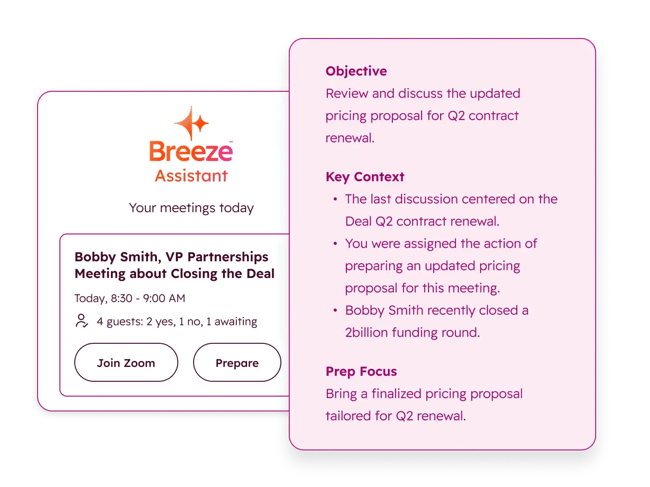
For example, Breeze prospecting agent can help reps research leads before they hop on a call. Reps can pair that information with the lead’s past actions found in HubSpot Smart CRM. The result is a strategy that’s personalized and well-thought-out, resulting in better performance.
Real-time account intelligence becomes the new relationship currency
The strongest sales relationships are built on relevance. Buyers expect reps to understand their industry, challenges, and internal priorities before a conversation begins. AI in CRM transforms this expectation from a heavy lift into a daily habit.
AI systems automatically consolidate signals across email, calls, website behavior, and support interactions in the CRM. Reps can review this data and understand what’s happening across the entire customer lifecycle. When the CRM becomes a real-time intelligence layer, relationship-building accelerates dramatically.
Agentic AI handles administrative work so reps can focus on selling
Most sales teams operate at a disadvantage: their CRM is only as accurate as the manual updates reps have time to make. Agentic AI solves this challenge. Autonomous systems, like HubSpot Data Hub, update records, enrich data, log activities, and maintain pipeline hygiene in the background.
This shift eliminates administrative errors, one of the biggest sources of pipeline inconsistency. Instead of chasing reps for updates, AI agents handle repetitive tasks automatically. Forecasts stay accurate, and teams can focus on relationship-building and closing deals.
Future of AI in Customer Relationship Management for Service Teams
Service teams sit at the center of customer relationships, and AI is redefining how they deliver fast support. The future of AI in customer relationship management allows service teams to predict intent, resolve issues before customers ask, and strengthen trust.
Below are the three most important AI trends shaping the future of CRM for service organizations.
Predictive service intelligence transforms support from reactive to proactive
Historically, customer service has relied on tickets, surveys, and agent intuition to understand customer needs. AI changes this dynamic by recognizing behavioral patterns, predicting friction before it escalates, and triggering the right intervention at the right time.
AI-powered CRMs analyze signals across the entire customer record. With HubSpot, reps can see recent purchases, product usage, sentiment from past interactions, website activity, and open support issues. Using this unified data foundation, predictive models can identify early churn risk and recommend outreach strategies tailored to each customer.
Agentic AI accelerates case resolution and improves customer satisfaction
In the future of CRM, service teams won’t manage tickets alone. Agentic AI will work alongside them. Agentic AI takes action, handling routine steps autonomously so reps can focus on high-impact conversations.
HubSpot’s Breeze offers a customer service agent. The agent can draft responses based on past interactions, summarize complex cases, gather missing information, and escalate issues automatically when criteria are met. The result is reduced resolution time. Human agents can then focus on relationship-building rather than administrative work.
Unified customer data enables personalized, end-to-end service experiences
Great service relies on context. AI can only be effective when it has access to a complete and accurate customer history. In modern CRMs, unified data empowers AI to personalize every interaction — not just based on support history, but on the customer’s entire relationship with the company.
When all teams operate from one source of truth, customers receive faster, more coherent, and more empathetic support. In the future of CRM, service teams no longer operate as problem-solvers alone. They become proactive relationship stewards, powered by AI, guided by unified data, and supported by agentic tools.
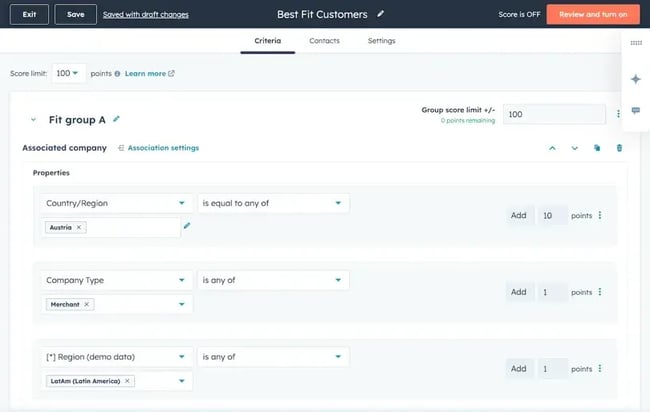
AI-powered lead scoring identifies revenue opportunities sooner
Traditional lead scoring depends on static rules. Modern AI-driven CRMs evaluate behavioral and demographic signals to find the prospects most likely to convert. Models continuously refine themselves based on real outcomes, improving accuracy over time.
Pro tip: HubSpot CRM uses predictive lead scoring to surface high-intent prospects. With targets in sight, reps can spend time where it matters.
AI-generated outreach and follow-up increases response rates
Consistent follow-up is one of the biggest drivers of closed-won deals, yet it’s also one of the most inconsistently executed tasks. AI copilots and agentic tools solve this by generating personalized outreach and workflows that never forget to follow up.
Pro tip: HubSpot’s Breeze can draft emails, summarize intent, and suggest next steps based on unified data. Sales Hub automates follow-ups while maintaining personalization.
Conversation intelligence elevates coaching and deal execution
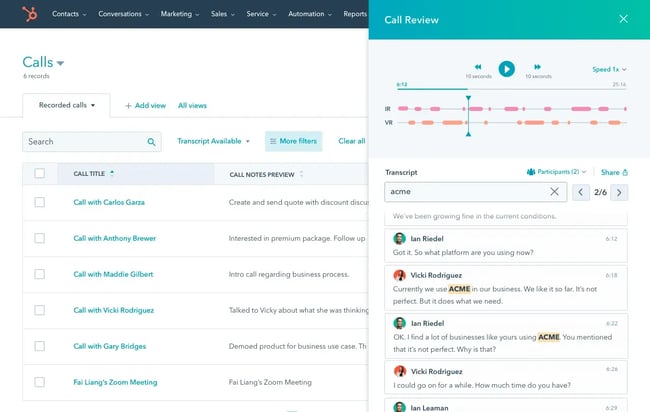
AI-powered conversation intelligence tools analyze call transcripts, identify themes, extract competitor mentions, and highlight coaching opportunities. Leaders get a real-time view of how reps perform, so they can coach without relying solely on subjective feedback.
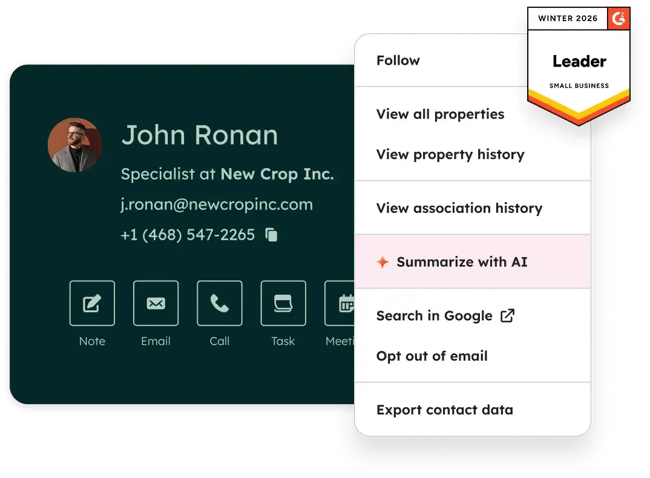
Pro tip: With HubSpot conversation intelligence, AI can summarize calls, tag objections, and capture commitments directly in the CRM. This eliminates manual note-taking and improves data accuracy across the team.
Predictive forecasting improves accuracy and resource planning
Forecasting has always been a challenge for sales organizations because it depends on human judgment, incomplete notes, and manual updates. AI forecasting models analyze historical performance, deal velocity, buyer engagement, and macro patterns to generate more reliable predictions.
Pro tip: Within Sales Hub, AI-driven forecasting tools highlight deal risk factors, compare predicted outcomes against rep-entered data, and allow leaders to reallocate resources accordingly.
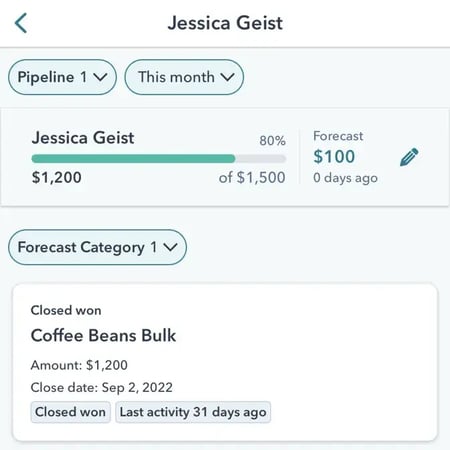
Unified AI insights enable cross-team alignment across marketing, sales, and service
The future of CRM depends on unified data. Centralized information creates a shared context across the entire customer lifecycle. AI can only personalize, predict, and act effectively when all teams operate from a single source of truth.
Pro tip: With HubSpot CRM, all interactions across marketing, sales, and service are captured in one place. AI analyzes this unified record to surface cross-functional insights, like risk signals from service tickets or marketing engagement patterns that impact sales velocity.
Frequently Asked Questions About the Future of AI in Customer Relationship Management
What is the future of CRM with AI?
The future of AI in customer relationship management is defined by unified data, predictive insights, and agentic automation. AI-powered CRMs like HubSpot can forecast behavior, personalize interactions at scale, and take autonomous steps. Go-to-market teams can then operate with greater precision.
How do I prepare my data for AI in CRM?
To prepare data for AI customer relationship management, teams must consolidate fragmented datasets into a unified source of customer truth. This includes standardizing field names, lifecycle stages, pipeline definitions, and contact properties.
Will AI replace sales or service roles?
AI will not replace sales or service representatives, but it will replace the manual work that slows them down. AI can manage data entry, note-taking, call summaries, ticket categorization, and basic troubleshooting. Human reps are still needed for their emotional intelligence and situational awareness required to build trust.
Which AI in CRM use cases pay off fastest?
AI tools that enhance accuracy, speed, and personalization without requiring major workflow changes deliver the quickest wins. HubSpot CRM and Sales Hub embed these capabilities natively, allowing quick adoption. Fastest wins include:
- Predictive lead scoring, which helps reps prioritize high-intent buyers immediately.
- AI-generated sales outreach, which reduces time to first touch and improves reply rates.
- Conversation intelligence, which surfaces insights from calls and boosts coaching quality.
- Automated CRM updates, which eliminate manual data entry and improve data quality.
How do I choose between a copilot and an AI agent?
Choosing between copilots and agents depends on whether your team needs assistance or autonomous execution.
- AI copilots assist humans by generating content, summarizing interactions, providing research, and recommending next steps. They act as “smart helpers” that speed up existing workflows without taking independent action.
- AI agents (like Breeze Agents) do the work for you. They can update records, draft and send messages, categorize tickets, trigger workflows, or escalate issues. Agents operate as autonomous teammates inside your CRM.
AI CRMs are the future
The future of AI in customer relationship management is clear: the next era of CRM will be defined by unified data, predictive intelligence, and agentic automation that supports every customer-facing function. AI is transforming CRMs from static databases into intelligent systems that personalize interactions, automate manual work, and surface insights across marketing, sales, and service. But none of these capabilities work without a single, reliable source of customer truth.
Consider HubSpot, as it offers one of the fastest paths to value, allowing teams to adopt AI incrementally, measure outcomes immediately, and scale use cases without managing a patchwork of disconnected tools.

